
Saline County VINE Coverage
Kansas Victim Information and Notification Everyday is the state service behind VINELink. The Kansas Attorney General describes it as a free, confidential, voluntary service for adults housed in Kansas county jails. That scope includes the Saline County jail layer. Operator help is available in more than 190 languages.
The boundary is unusually important here. Kansas VINE expressly excludes people held in KDOC state prisons. Use KASPER for a person transferred from Saline County Jail into state custody. VINE also does not cover federal Bureau of Prisons custody. No single lookup spans the county jail, KDOC, federal prison, and court systems.
| Custody path | Correct lookup | What it answers |
|---|---|---|
| Saline County Jail | Kansas VINE and Sheriff | Current custody changes and alerts |
| KDOC prison or parole | KASPER | State custody, supervision, anticipated date, discharge |
| Federal sentence | BOP locator | Federal custody and displayed release record |
| Legal case outcome | District or municipal court | Bond, dismissal, sentence, probation, commitment |
Search a Saline VINE Record
Use VINE for one specific person, not as a broad recent-release list. A name alone can match more than one person. Compare all identifiers the live record provides before saving a status or registering for notice.
- Open VINELink and choose Kansas.
- Enter the person’s name and, when known or offered, the offender or booking identifier.
- Compare the displayed identifying details. Do not choose solely because the name looks right.
- Open the custody record and read the present jail or custody wording.
- If the status changed, save the exact wording and timestamp, then confirm it with Saline County and the court.
The successful manifest capture comes from the official VINELink application.
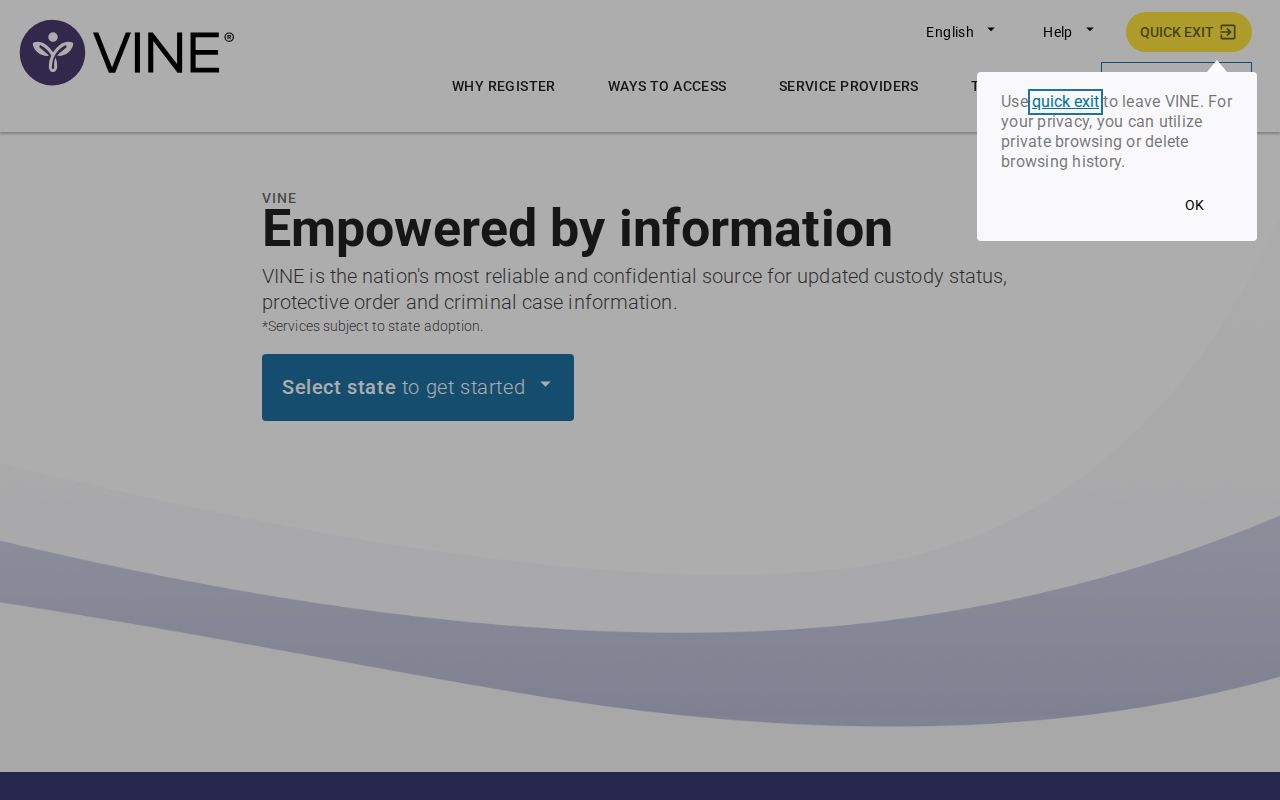
The live interface is the correct place to read current labels. Static Kansas materials do not prescribe one standard post-release label or a complete result-field list.
Read Saline VINE Results
Record what the screen actually says. Release, transfer, escape, and a record transition are not the same event. A transfer means custody moved to another authority. It does not establish that the person returned to the community. If a name vanishes, check spelling and identifiers, contact the jail, and look for a transfer into KASPER before drawing a conclusion.
| Live item | How to use it |
|---|---|
| Person identifiers | Confirm the record belongs to the intended person. |
| Custody wording | Quote the displayed state without expanding its meaning. |
| Custody event | Distinguish release, transfer, escape, and other changes. |
| Event timestamp | Preserve it with the exact message wording. |
| Facility information | Contact that custodian for direct confirmation. |
| Notification choices | Register while the person remains in custody. |
Important: No VINE match is not proof of release. Scope limits, transfer, spelling, identifiers, or a data transition can explain the absence.
For a lasting Saline County release record, request the Sheriff’s admission and physical release timestamps plus the recorded disposition or destination. The court docket can explain the legal action, but it may not show the exact time someone left the jail.
Register Saline Release Notifications
Registration is strongest while the person remains in custody. Kansas materials identify phone, email, text, TTY, and available in-app delivery. Choose the channel that can be monitored and keep the Sheriff’s jail number as a separate confirmation route.
- Open the correct person’s custody record and select registration or notification.
- Choose phone, email, text, TTY, or an available app option.
- For phone registration, create a four-digit PIN.
- When the automated call arrives, listen to the message and enter the PIN followed by
#. - That acknowledgment stops repeat calls. Email registration sends a custody-change message and does not use the phone PIN.
- Save the alert time and exact event wording, then verify the event with the jail.
VINE is a notification system, not the legal disposition record. A municipal bond action or district-court order may help explain why release processing began. Another hold can still prevent physical release, and a transfer alert may point to a new custodian instead.
Kansas VINE Phone Conflict
Current official sources conflict on the Kansas VINE telephone number. The Attorney General web page displays 1-866-574-7463, while the official guide and a February 2026 Attorney General release display 1-866-574-8463. Two current sources support 1-866-574-8463, so that is the stronger phone route, with this conflict disclosed. The TTY number is 1-866-847-1298.
Use the online VINELink route first when possible. It reduces the risk of relying on the conflicting digit and lets the searcher compare the live person record before registration. If phone access fails, consult the current Kansas VINE page rather than an old third-party listing.
County VINE, Not KDOC
This Kansas routing rule is the main local distinction. VINE follows adults in county jails. KASPER follows KDOC prisoners, parolees, postrelease supervision, and discharged sentences. If Saline County Jail transfers someone to the Secretary of Corrections, leaving the county roster is not community release.
After a jail-to-prison transfer, search KASPER once intake data reaches KDOC. Facility movements and Inmate status indicate continuing state custody. Parole or postrelease status reflects later physical prison release with supervision. Discharged is the state completion lead. Kansas VINE cannot calculate or monitor that prison release.
The same separation applies to the KBI Registered Offender site. That registry covers only people with a qualifying registration duty. It is not a general Saline County release list, and presence there does not supply a jail release date.
Confirm Saline County Release
When VINELink sends an alert, preserve its time and exact words. Then check whether the event is release, transfer, or escape. Call Saline County Jail at 785-826-6502 for current custody confirmation. For historical proof, request the Sheriff’s release record and inspect the correct court case.
A municipal case belongs in Salina FullCourt, while state and county matters use the Kansas district-court system. A posted bond can support the legal context, but the Sheriff’s release timestamp is the evidence of physical exit. If another hold existed, action in one case may not have resulted in release.
For a broader custody-specific sequence, use the Saline County released inmate search. VINE serves one role well: timely county-jail custody notice. Direct agency records finish the verification.
If an alert says transfer, identify the receiving custodian before continuing. A transfer to KDOC leads to KASPER. A transfer to another county requires that county’s jail and VINE record. Federal and immigration transfers use their own systems. Keep the original Saline message because it documents when the county-jail status changed, but do not rewrite it as proof that all custody ended.
Historical checks need a different approach. VINE works best as a prospective notification tool, and registration is most useful before the event. If the person is no longer returned by the live search, request the existing Saline County booking summary, admission time, release time, and disposition or destination if maintained. Ask the agency for a fee estimate and a segregable record when part of the file is restricted. Court records can then connect the custody event to bond, dismissal, sentence, probation, or commitment.
Keep notes in plain terms. State that VINE reported a custody change at the displayed time. Then state what the jail or court separately confirmed. This avoids treating a private alert as a complete historical record and preserves the difference between notification, physical custody evidence, and legal disposition.
A same-day verification should also account for data lag. First note when VINELink was checked. Next call Saline County Jail and ask whether the person remains in that facility or left through a recorded event. If staff identify another custodian, continue in that agency’s official system. Finally, review the court docket for the order that may explain the change. This sequence guards against calling a routine transfer a community release.
Do not rely on a screenshot alone after the live status changes. Preserve the source URL, capture time, person identifiers used, and exact event wording. Those notes make it clear what the service reported at that moment. The Sheriff’s record remains the better source for admission and release timestamps, while the court remains the better source for the legal reason.
Resolve Saline VINE Mismatches
A missing or changed result needs a structured follow-up. Search the Saline Housed page by first and last name to see whether the person still appears in current jail custody. Check the county’s separate Booking Activity page as a daily updated lead, but do not assume it contains a release date, reason, photograph, or fixed history window. Those fields were not verified in the accessible research response.
Next, call Saline County Jail at 785-826-6502 and ask a narrow custody question. If the person left the facility, ask whether the maintained record identifies release or transfer and a receiving authority. A transfer into KDOC should lead to KASPER after intake data posts. A city case should also be checked in Salina FullCourt, while a state or county case belongs in the Kansas district-court portal.
If durable proof is needed, submit a Saline County open-records request for the existing booking summary, admission and physical release timestamps, booking number, and recorded disposition or destination. Ask for the photograph separately. Kansas open-records law does not require an agency to create an answer or infer a release reason that its existing record does not contain.
Saline Alerts and Court Outcomes
A VINE release alert and a court disposition serve different purposes. The alert reports a custody change. A court entry may show bond, dismissal, probation, sentencing, commitment, or a later order. Neither source should be stretched beyond what it records. A bond entry can explain why release processing began, but another hold may keep the person jailed.
Salina Municipal Court sends every person sentenced to jail to Saline County Jail. For a municipal matter, FullCourt explains the city-code case while the Sheriff’s record and VINE address physical custody. The 28th Judicial District record performs the legal role for state and county cases. This two-court structure is why choosing the correct docket matters after an alert.
When a VINE event is followed by a court order, report them as two corroborating facts with their own times. Do not assume the court filing time equals the jail exit time. For an older event, the court record may remain public after the live VINE result is gone, subject to sealing, expungement, juvenile restrictions, and other access limits.