
Saline Parole Versus Probation
Parole and postrelease supervision follow release from Kansas Department of Corrections authority. KDOC Parole Services provides field supervision. Probation is a court-ordered alternative or follow-up to confinement and is handled locally by the 28th Judicial District Court Services or Community Corrections. A release from Saline County Jail can lead straight to probation without any state-prison parole case.
The label matters because each office keeps a different part of the record. KASPER, the Kansas Adult Supervised Population Electronic Repository, may show Parole, Discharged, a custody or supervision level, and a parole office. Local Court Services confirms ordinary court probation. Community Corrections is the better source for an active intensive community-corrections case, especially because KASPER does not carry newer community-corrections events beyond its stated cutoff.
| Status | Who imposes it | Where to verify |
|---|---|---|
| Parole | Kansas Prisoner Review Board | KASPER and the listed KDOC parole office |
| Postrelease supervision | Statute and sentence computation | KASPER, KDOC, and the assigned parole office |
| Probation | District or municipal court | Court docket and Court Services |
| Community Corrections | Court placement | 28th Judicial District Community Corrections |
| Discharged | Completion of controlling sentence or supervision | KASPER or the controlling court record |
Check Saline Post-Release Status
Start with the system that imposed supervision. A Saline conviction does not prove that the person lives in Saline County or reports to the Salina office. Likewise, supervision in Saline County does not prove the conviction arose here. Match a full name with the KDOC number, date of birth, case number, conviction county, and other identifiers before relying on a result.
- Open the KASPER search for a person who entered KDOC custody.
- Search by KDOC number when known, or use name and identifiers. Review the supervision type and current status.
- Read the parole-office field. Contact that office to confirm current routing rather than assuming Salina from the conviction.
- For court probation, inspect the Saline district or Salina municipal docket and contact the named local probation agency.
- For durable proof of completion, obtain the discharge entry or court order from the agency that controlled the sentence.
KASPER separates Parole from Discharged. Parole means prison confinement has ended under conditions, but the sentence or supervision has not necessarily ended. Discharged is the stronger KDOC lead that the state sentence and its supervision have concluded. A county court may use a different completion order for probation.
The official Prisoner Review Board process image shows how Kansas defines parole decisions.

That Board process applies to eligible KDOC cases, not ordinary Saline County court probation.
Saline Supervision Office Routes
The Salina Parole Office is a named KDOC North-region office. Its region includes Saline and fourteen other counties, so staff can confirm routing when KASPER identifies that office. Court Services and Community Corrections remain separate. Direct the question to the agency shown in the record.
Salina Parole Office
919 E. Prescott, Suite 300
Salina, KS 67401
785-827-2584
Saline County Court Services
In person: 251 N. 10th Street, Salina
Mail: 300 W. Ash, Room 307, Salina, KS 67401
785-309-5842
Community Corrections
309 S. Broadway Boulevard, Salina, KS 67401
785-826-6590
Monday through Thursday, 7:30 a.m. to 6 p.m.
Court Services publishes a specific rule for probationers: law-enforcement contact must be reported within 24 hours. Its after-hours direction calls for contact the next morning, or Monday after a weekend. That local rule illustrates why probation instructions should never be inferred from a parole record.
Saline Absconder Status Checks
KASPER has a dedicated parole absconder search with a filter for “Parole Supervision Location Before Absconding,” including Saline County. Under K.S.A. 75-5217, absconding means knowingly avoiding supervision or knowingly making one’s whereabouts unknown to the supervising officer. It is a supervision status, not a new conviction.
The list updates each working day. A Saline filter result does not establish that the person is now in Saline County, currently jailed, or newly convicted. KDOC expressly warns that the public listing must not be the sole basis for an arrest. Use it as a status lead, then contact the supervising office or law-enforcement agency through normal official channels.
The official Saline-filterable page shows the location field used for the listing.
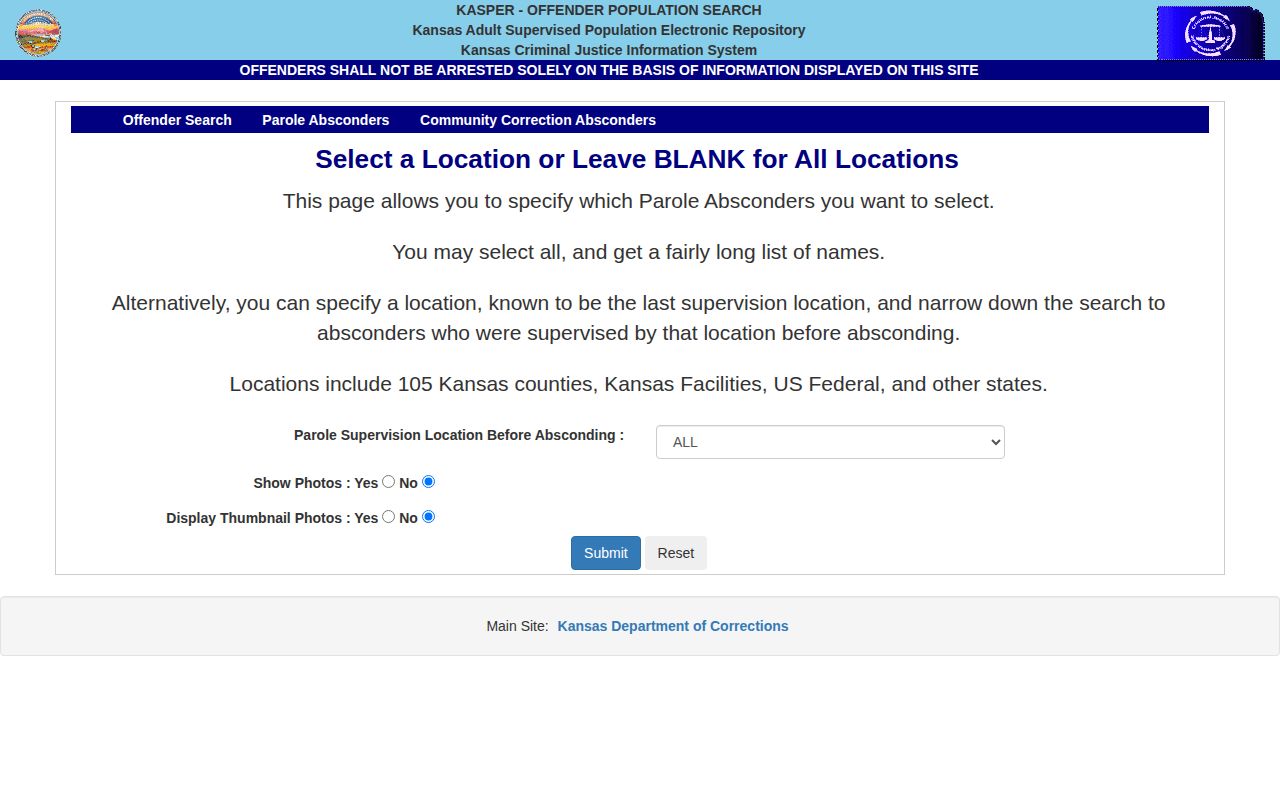
The location describes supervision before absconding, not a verified present address.
Saline Parole Hearing Records
The Kansas Prisoner Review Board publishes a monthly public-comment and hearing cycle. Public-comment forums occur one month before a parole hearing. A prospective list can name Saline as the county of conviction, but the Board warns that conviction county may not be the person’s home or release-return county.
A calendar entry proves a scheduled eligibility process, not a parole grant and not physical release. The Board defines Parole as a finding that a person is suitable for conditional release. Continue postpones a decision for more information, votes, deliberation, or evaluation. Pass denies release for a stated period. K.S.A. 22-3717 controls eligibility, but offense date, sentence type, mandatory minimums, and special rules prevent a single formula.
The official monthly schedule illustrates the prospective cycle.

After a hearing, check updated KASPER movement and supervision details or use the Board’s records route. No official public person-by-person decisions database was verified in the research sweep.
Saline Release Support Through REACH
The Sheriff’s REACH program is expressly available while a person is in custody or after release. Its practical help can include document assistance, food guidance, mental-health follow-up coordination, medical information in a requested release packet, and a backpack with basic items. REACH is a local continuity resource. It does not replace parole reporting, probation terms, or a court order.
Someone leaving Saline County Jail should identify the supervision office first, then ask REACH about permitted support. A parolee follows KDOC direction. A probationer follows the court agency’s instructions. Timely contact matters because support services and legal reporting duties serve different purposes.
When Saline Supervision Ends
Discharge means the controlling sentence or supervision has ended. It differs from parole, probation, and community corrections, all of which leave active legal duties in place. K.S.A. 22-3722 addresses sentence service and discharge in the KDOC setting. KASPER retains discharged-sentence records subject to KDOC removal rules, so a Discharged result can remain searchable after active supervision ends.
- Parole
- Conditional community release in a KDOC case.
- Probation
- Court supervision that may follow or replace confinement.
- Absconder
- A reported status for knowingly avoiding supervision or concealing whereabouts.
- Discharge
- Completion of the sentence or supervision controlled by the reporting agency.
For the underlying release event, compare the supervision record with the court case and the county or state custody record. The Saline County release search explains those custody-specific paths. One status page should not be made to answer every legal question.
A final record should identify the agency, status wording, and date checked. If KASPER still says Parole, do not describe the person as discharged. If a court docket still shows probation, obtain the later termination order before stating that supervision ended. Release from physical custody and release from legal supervision can occur years apart. The source that imposed the duty is the source that can confirm its end.
Parole-hearing records need the same care. Guidelines and determinate cases often reach mandatory postrelease through sentence computation, while old-law, indeterminate, and some off-grid cases receive parole review. The Board may review a release plan in a determinate case without power to advance or delay the statutory date. No universal first-eligibility formula applies. Offense date, mandatory minimum, sentence form, and special provisions all matter.
Saline Supervision Record Cross-Checks
A supervision result is strongest when it agrees with the controlling court and custody records. For a KDOC case, KASPER may display the conviction county, case number, movements, supervision level, parole office, and current status. Compare those fields before connecting the record to Saline County. Conviction County and Supervision County are separate search choices. A person convicted in Saline may report elsewhere, while a person convicted in another county may be supervised through the Salina office.
Local probation requires a different cross-check. Search the Kansas district-court portal for a felony or county case and Salina FullCourt for a city-code matter. Look for the judgment, probation order, revocation entry, modification, and later discharge or termination order. A court record explains the legal basis. It does not by itself prove where the person is physically located today. Court Services or Community Corrections can confirm which local office controls an active case.
When records conflict, do not merge the labels. Note the source and date for each status, then contact the agency that owns the newer event. A county Housed result concerns current jail custody. KASPER concerns KDOC custody and supervision. A court docket concerns judicial orders. The three sources may update on different schedules, and each answers a different part of the release history.
Saline Violations and Warrants
A supervision violation does not automatically establish a new conviction or current confinement. The supervising agency may investigate, change conditions, seek a warrant, or begin revocation proceedings. The court or Board determines the legal outcome through its own process. If KASPER reports Absconder, quote that status narrowly and preserve the working-day date of the search.
Saline Court Services publishes a route for addressing an active probation-violation warrant. Its instructions may include contacting the jail or surrendering at Saline County Jail, 800 E. Pacific Avenue. That is local probation guidance, not a general rule for KDOC parole cases. Someone dealing with state parole should use the office shown in KASPER and follow KDOC direction.
VINE may later provide a county-jail custody notification if a person enters the jail, but VINE is not a parole or probation status service. Kansas VINE excludes KDOC prison residents and does not replace an absconder listing, court warrant record, or supervising-office confirmation. Keeping these channels separate prevents a custody alert from being mistaken for the final result of a violation case.