
Saline Projected Versus Actual Release
Kansas uses the exact public KASPER label Anticipated release date. It is a sentence-computation field for a KDOC case. It is not the same as the actual date and time a person leaves custody. The anticipated date can move as credits, sentences, court entries, and other authority are applied.
A pretrial Saline County detainee often has no fixed release date. Bond, dismissal, plea, trial, sentencing, and holds remain unresolved. A county-sentence date comes from the court’s journal entry and the jail’s calculation. Do not apply the KDOC prison formula to a county case.
Scheduled versus actual: Treat a future date as a current calculation, not a promise. Verify release after the date through the updated custody record.
| Case type | Date source | Main limit |
|---|---|---|
| Pretrial county detention | Court and jail | A fixed date may not exist |
| County jail sentence | Journal entry and jail calculation | Do not use the KDOC formula |
| KDOC prison sentence | KASPER Anticipated release date | The computed date can change |
| Old-law parole case | KDOC and Prisoner Review Board | Eligibility is not a release grant |
| Federal sentence | BOP locator | Separate federal system |
Find a Saline Release Date
Begin with custody, not the person’s county of conviction alone. Someone may leave Saline County Jail for KDOC, another jail, federal authority, immigration custody, treatment, or the community. A transfer to another custodian is not community release.
- Check the Saline County Housed view to determine whether the person appears in current jail custody.
- Read the controlling district or municipal court record for bond, sentence, commitment, and later orders.
- For KDOC involvement, open KASPER and match the correct identity.
- Record the exact Anticipated release date, current status, facility movements, and supervising office shown.
- For a county sentence, request the journal entry and the jail’s release calculation instead.
- Ask KDOC Sentence Computation at 785-296-3317 about a specific state calculation discrepancy.
- After the date, confirm actual release through updated custody, movement, or supervision records.
The official KASPER entry explains the state search’s terms and limits.
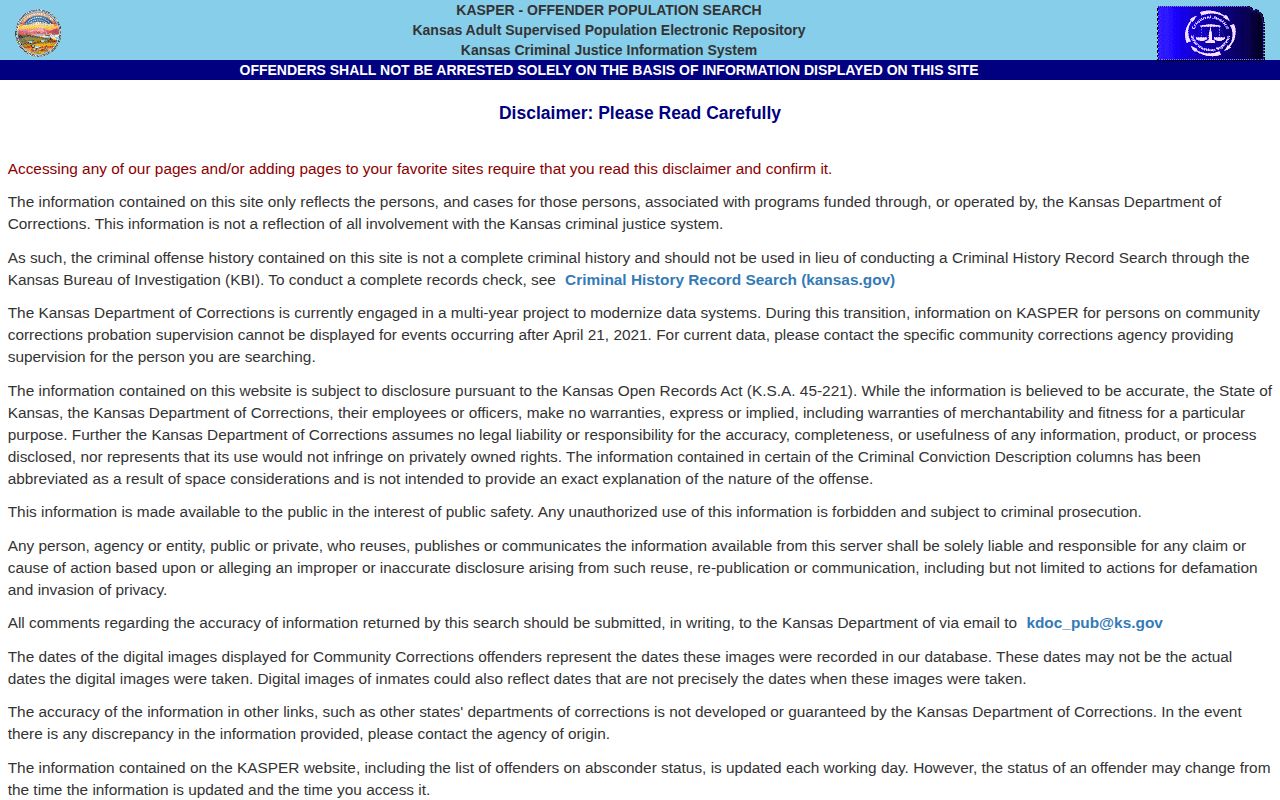
Accept the disclaimer only to reach the state record. The search covers KDOC cases, not an ordinary Saline County jail release.
Search Saline KASPER Fields
KASPER can search by KDOC number or by name and identifiers. Its advanced choices include birth date, age range, conviction county, supervision county, location, facility, and supervision type. Conviction County equals Saline and Supervision County equals Saline answer different questions. Confirm which relationship is known.
| Field | Release-date use |
|---|---|
| KDOC number | Strong identifier for the correct state record |
| Anticipated release date | Current computed state-prison date |
| Inmate | Continuing prison custody |
| Parole or postrelease | Prison release with active supervision |
| Discharged | State sentence and supervision completion lead |
| Facility movements | Distinguishes transfer from community release |
| Parole office | Routes later supervision confirmation |
The captured KASPER search fields show the available identifiers and supervision choices.
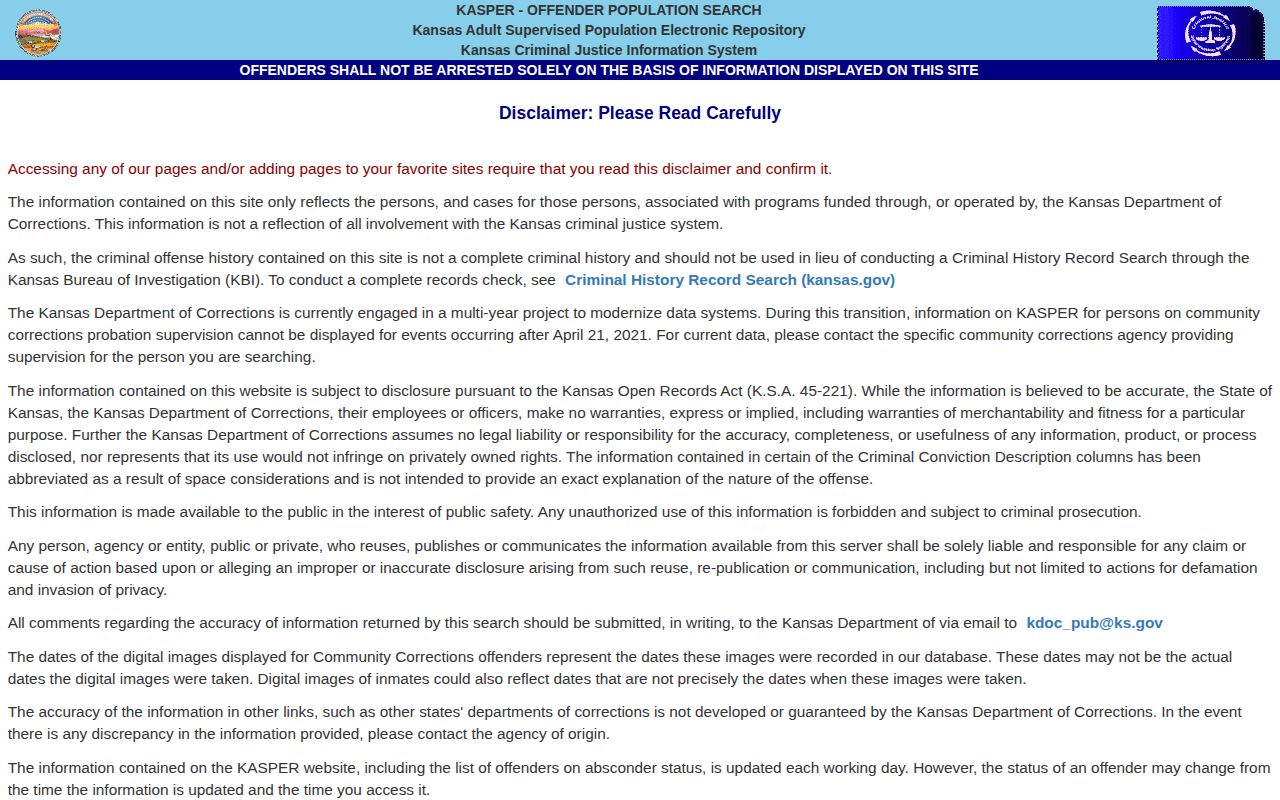
Use more than a name when possible. A similarly named person or the wrong county field can produce a false match.
Kansas Good-Time Rules
K.S.A. 21-6821 authorizes good-time rules for Kansas guideline sentences. For crimes committed on or after July 1, 1993, the general maximum is 15 percent of the prison portion. That creates the familiar “serve 85 percent” shorthand, but the shorthand is not a universal Kansas rule.
Specified nondrug severity-level 7 through 10 crimes committed on or after January 1, 2008 may earn up to 20 percent. Certain lower-severity drug categories also have a 20 percent cap. The statute further permits up to 120 days of program credit for eligible inmates who complete qualifying programs. Eligibility is limited, and credits must be earned and retained. Completion of sex-offender treatment does not earn that program credit.
Some sentence types add credited prison time to postrelease supervision. Old-law crimes before July 1, 1993 use K.S.A. 22-3725 and parole or conditional-release concepts. Mandatory terms and special sentencing provisions can also control. These differences are why an arithmetic estimate should never replace KDOC computation.
The KDOC locating FAQ identifies the public field and explains the information retained in KASPER.

The official label is “Anticipated release date.” Cite it with the date the record was accessed.
Why Saline Release Dates Change
A computed date reflects the information applied at that point. Changes may shorten or extend the apparent path without meaning the prior display was fabricated. The correct response is to save the old value, note the access date, and ask the responsible agency about the calculation.
| Factor | Possible effect |
|---|---|
| Good time | Earned, forfeited, restored, or withheld credit changes computation |
| Program credit | Eligible completion can reduce time within statutory limits |
| Court credit | Corrected jail or prison credit can alter the date |
| Sentence structure | Concurrent or consecutive terms change the total |
| New order | Amended entry, revocation, or new sentence changes authority |
| Detainer or hold | Another authority may take custody on the displayed date |
| Data timing | The public record may lag an official computation update |
A detainer is a notice that another authority may seek custody. It can turn a departure from one facility into a transfer, not release home. Likewise, parole eligibility is not a grant. A Prisoner Review Board calendar proves only a prospective process.
County Sentences and Pretrial Custody
For a Saline County Jail sentence, request the court’s journal entry and the jail calculation. The journal entry supplies the legal sentence and applicable credit ordered by the court. The jail maintains the custody-side calculation. Ask for the date as maintained instead of creating an estimate from a docket summary.
Pretrial detention works differently. A cash bond in a Salina municipal docket is meaningful legal context, but it does not prove the exact exit time. Another hold can keep the person jailed after action in one case. The Sheriff’s release timestamp is the physical-custody evidence.
If the district docket says the defendant was committed to KDOC, leaving the county jail is a state-custody transfer. Search KASPER after intake posts. Later movement and status fields show whether the person remains an inmate, has reached parole or postrelease supervision, or has been discharged.
Confirm the Saline Release Event
After an anticipated date passes, reopen KASPER. Review the status and movement history. Parole or postrelease means the person has left prison confinement under continuing supervision. Discharged means KDOC reports completion of the state sentence and supervision. Neither status should be confused with local court probation.
For a pending Saline County jail release, the VINE Inmate Check can provide a custody-change alert. Kansas VINE does not monitor KDOC state-prison releases, and it does not calculate sentences. Confirm a county event with the Sheriff and the court; confirm a prison event through KASPER, KDOC Sentence Computation, and the assigned parole office when applicable.
- Anticipated release date
- KDOC’s public label for a computed future date.
- Actual release
- The recorded event when custody ends or moves.
- Detainer
- A request or notice tied to another authority’s custody interest.
- Discharge
- Completion of the sentence or supervision reported by the controlling system.
Save a dated copy or written note of the public status when timing matters. If KASPER later changes, compare the new value rather than presenting the first date as a broken promise. Sentence Computation is the proper channel for a specific KDOC discrepancy. The public search offers useful fields, but it does not expose every calculation step or replace the official sentence record.
County and court requests should be narrow. Identify the person, booking or case number when known, and the date range. Ask for the existing journal entry, booking summary, admission timestamp, release timestamp, and recorded destination or disposition. An agency need not create a new calculation or infer a reason its files do not contain. A precise request is more likely to locate the relevant record.
When no older county record is found, ask which retention schedule and record series controlled the search. Confirm that aliases, the correct range, and any other custodian were checked. A retention gap does not prove the detention never happened. Use the court case for the legal history and KASPER only if KDOC took custody.
A future KASPER date should be quoted exactly and paired with the access date. Avoid converting it to an expected hour or release location. Saline County research did not verify a public exit door, release-processing hour, weekend schedule, property-return sequence, or transportation promise. Those details can change for safety and operational reasons. Contact the current custodian before arranging pickup or travel.
If the date arrives and KASPER still shows Inmate, check for a later data update, a recalculation, a new sentence, or an amended court entry. If it changes to Parole, the person has left prison confinement but remains under supervision. If it changes to Discharged, compare the conviction county and case number before tying the record to a Saline matter. Each label answers a narrow question.
Saline Parole Date Distinctions
Parole eligibility and an anticipated release date are not synonyms. The Kansas Prisoner Review Board’s monthly list is prospective. It identifies a public-comment and hearing cycle, not a grant and not physical release. The county shown is the county of conviction and may differ from the person’s home, supervision county, or planned return location.
Board outcomes also require exact wording. Parole means the Board found an eligible person suitable for conditional release. Continue postpones the decision for more deliberation, information, votes, or evaluation. Pass denies release for a stated period. After a hearing, use updated KASPER movements and supervision details or the Board’s records route. No official public person-by-person decisions database was verified.
K.S.A. 22-3717 governs eligibility and hearing procedure. Old-law, indeterminate, and certain off-grid cases may follow parole-hearing rules. Guidelines and determinate sentences generally reach mandatory postrelease through sentence computation. For those determinate cases, the Board reviews a release plan but cannot move the statutory release date forward or backward.
Document Saline Date Changes
When a displayed date changes, keep both values with their access dates and identify the system. Check the court docket for an amended journal entry, revocation, new sentence, or corrected jail credit. Review KASPER movements and current status. Then direct a state computation question to KDOC Sentence Computation rather than attempting to reverse-engineer the figure.
A person can leave one custodian on the anticipated date and enter another. A detainer, federal hold, immigration transfer, or another county case can prevent release to the community. Describe the event as a transfer until the receiving system confirms that its custody also ended. Kansas VINE cannot resolve a KDOC prison date because its Kansas coverage is limited to county jails.
For a Saline County sentence, ask the jail and court to state the date they maintain. Research did not verify a universal county good-time formula, fixed release-processing hour, weekend adjustment, or pickup process. Those operational facts should come from the current custodian. The absence of a public formula is a reason to request the official calculation, not a reason to import another county’s practice.